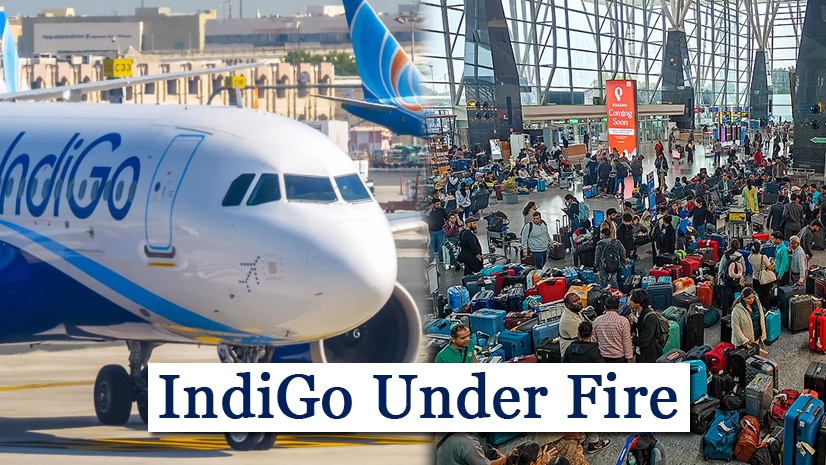
IndiGo Under Fire: The Indian Aviation Industry has fallen into a crisis as never before, and it is mainly due to a giant operational outburst of IndiGo, the largest carrier of the nation, which controls more than 60 per cent of the domestic market. The extended interruption that had started off quietly but soon grew out of proportion resulted in the cancellation of more than a thousand flights in one day and thousands of passengers being left all over the country at the heart of the peak holiday season.
It is a report giving a breakdown of the crisis, the reasons that led to it, the decisive interventions of the government and the position of the passengers affected.
New News and Government Intervention
The acuity of the crisis has caused the immediate and decisive response of the Ministry of Civil Aviation and the Directorate General of Civil Aviation (DGCA), which indicates the systemic nature of the activities of IndiGo in connectivity within the country.
Governmental Directives and Regulatory Act
Show-Cause Notice to CEO: DGCA provided a show-cause notice to the CEO of IndiGo, Pieter Elbers, and Accountable Manager, blaming the top management in the cause of the long-term operational failure and stating that the highest management did not consider the following issues important: planning, oversight, and resource management. They were first allowed 24 hours to justify the reason why they are not to undergo enforcement.
Refund Deadline Imposed: The central government directed IndiGo to implement all outstanding passenger refunds on the cancelled or disrupted flights up to 8:00 PM on Sunday, December 7, 2025. Lack of compliance was threatened to initiate an instant regulatory response. On Sunday, the airline said that it had refunded about 610 crore.
Airfare Caps: As various airlines were reportedly charging their passengers huge fees due to the so-called surge pricing on its impacted routes, the government issued temporary caps on airfare to save the desperate passengers. Domestic routes fare was limited with the maximum 18,000 fare to any flight above 1,500 km to be fixed until the situation is fully stabilised.
Operational Normalisation Timeline: The Ministry of Civil Aviation applied the Bharatiya Vayuyan Adhiniyam and allotted the airline a two-day deadline (compared to the 21 days that the airline had petitioned) to bring the operations back to full capacity. It is now expected to be fully stable by December 10-15.
Relief on New Norms: To ensure that the situation returned to normal, the DGCA momentarily granted certain significant relaxations concerning the new Flight Duty Time Limitation (FDTL) standards on the Airbus A320 fleet of IndiGo up to February 10, 2026.
Status and Relief Measures of Passengers
Massive cancellations and delays are still experienced in most international airports, such as Delhi, Mumbai, and Bengaluru, as thousands of travellers continue to be impacted. The scenes of anarchy, very long queues, and the passengers complaining about the absence of communication and the presence of lost baggage were described.
Airline Apology and Action: IndiGo CEO Pieter Elbers has made an apology on the inconvenience caused, which is indeed a major one. The airline said that it is being proactive in cancelling its flights in order to restart its system and that it is handling all customer refunds on priority.
Baggage Return: The Government pointed IndiGo to trace and deliver all the separated baggage to the preferred address of the passengers within 48 hours. The airline had been able to deliver a reported 3,000 missing bags by Sunday.
Waiver of Fees: The airlines have been advised not to charge rescheduling fees to the passengers who have been inconvenienced due to cancellations or significant delays. IndiGo has also provided an absolute waiver of all cancellations/reschedule requests on the route of travel between December 5 and December 15.
Support that is needed: Airlines were obliged to provide hotel rooms, meals, and other necessary services to the passengers who got stuck in long delays, and special assistance to vulnerable travellers.
Why This Crisis? Root Cause Analysis Factors
This unprecedented collapse of operations is caused by multiple factors, the core of which is the acute introduction of new, strict regulatory norms in collision with the lean operating model of IndiGo and the loopholes in its planning.
Basic Factor: Norms of New Flight Duty Time Limitation (FDTL)
Regulatory Change: The basic catalyst was the full adoption of the second round of amended DGCA FDTL norms on pilots, to be effective on November 1, 2025, following a High Court order to avoid fatigue in pilots.
Tighter Restrictions: These new regulations increased weekly rest time (48 hours of rest was mandatory), the definition of night duty (midnight-5 AM and midnight-6 AM), and above all, the number of allowed night landings of pilots to two per week.
System Overload: These extreme caps had a very high level of reduction in the available crew hours, especially the wide late-night network of operation and the high-utilisation schedule of IndiGo.
Senescence Factors: Operational Stress and Planning Lapses
Poor Pilot Buffer: IndiGo had a low-cost business model, which had a very small pilot buffer (around 4 per cent of the crew strength was reported to be), which was highly efficient. According to the allegations by officials and pilot associations, the airline did not sufficiently hire or speed up training to prepare in advance of the new rules, although it had two years to prepare. The CEO has maintained that there is no shortage of pilots, yet confessed that the buffer was small.
Rostering Failure: The new FDTL norms put the already complicated system of crew rostering in a daze. The system of the airline could not efficiently change in response to the new regulations of rest and night landing, which resulted in the domino effect of delays and cancellations because required flight rosters were not met.
Peak Season and Weather: The disruption was at the peak season of the holiday travel in the month of December, making the effects worse since there was high demand. Also, the problem with the weather and congestion in the airports added to the initial delays, which were in turn transformed into mass cancellations due to the lack of pilots.
Too Big To Fail (TBTF) Factor: Since the domestic market is dominated by IndiGo, a breakdown of its operations caused a systemic effect on air transportation in the country, compelling the regulator to allow short-term relaxations- an intervention that highlights the dominance of the airline in the market and the vulnerability of the entire system.
IndiGo has already started a root cause analysis to find the extent to which each cause contributed, although regulatory bodies have explicitly suggested a lack of preparedness and bad planning under the new FDTL requirements to have been the main cause of the massive failure.
Declaration
etime.in is not affiliated with any government agency, official department, or authority. The information provided in this post/website is for informational purposes only. We are not answerable for any damages or errors related to the use of our content. Aspirants should always verify the information directly from the official website or notification before taking any action.