Kerala SIR Case: The Supreme Court of India now ponders over a group of significant petitions questioning the Special Intensified Revision (SIR) of voter lists in a number of states, among them, Kerala. It has emerged as a pivotal legal struggle, with the Election Commission of India (ECI) in opposition to its statutory powers on one side, and the issue of logistical and constitutional issues by states and political parties on the other.
Notably, this use of the term SIR means Special Intensified Revision of Electoral List, a gigantic, nationwide project by the ECI to clean the voter lists following a successful pilot exercise in Bihar.
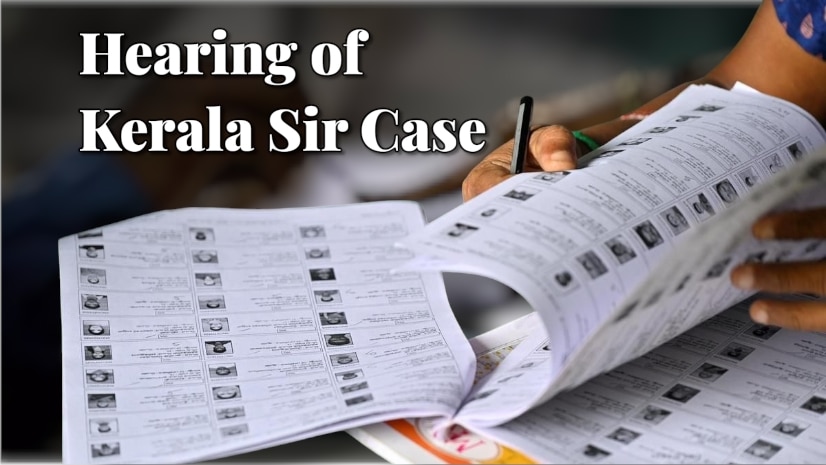
Hearing last updated on November 26, 2025
The Supreme Court held its session on the process of SIR on Wednesday, November 26, 2025, during which the plea of Kerala was taken into consideration due to its unusual timing conflict:
Time clash: Kerala government and other political parties, such as the CPI(M) and the IUML, have been trying to get the SIR exercise postponed that was to be held between November 4 to December 4, 2025. Their primary point is that they want to run the Local Self-Government Institution (LSGI) elections in Kerala on the same day, December 9 and 11.
Resource crunch argument The state government had cited that it is virtually impossible to simultaneously conduct the “arduous” SIR exercise, which necessitates the deployment of more than 1.76 lakh personnel in the government services, and the LSGI elections, and this would create an administrative gridlock, which would strain the limited human resources in the state.
The arguments and arguments of ECI: Senior advocate Rakesh Dwivedi, representing the Election Commission, was extremely critical of the arguments presented by the state, saying that it was his feeling that both the exercises would be undertaken without any serious problems. The Election Commission addressed the bench, informing that the work was already going on well in Kerala, saying:
“There is no problem. Over 90 per cent of the counting forms have already been dispatched, and over 50 per cent of the forms have been digitalised.
The ECI also indicated that in order to minimise conflict of resources, dedicated staff have been engaged to carry out SIR functions as Booth Level Officers (BLOs) and are not the same staff that work with LSGI elections.
Order of the court: Hearing ended, the court made the following orders:
The Kerala SIR case has ordered ECI and Kerala State Election Commission (SEC) to submit a full status report/counter affidavit by Monday, December 1, 2025. The case of Kerala SIR has been included in the list of those to be heard by the Supreme Court again on December 2, 2025.
Burden of proof and constitutional challenge
Not counting the time factor in Kerala, the Supreme Court is also debating on the constitutionality of the SIR exercise, which has been attacked by various petitioners representing different parts of the country (including Tamil Nadu and West Bengal) and have claimed that it is an extraneous measure.
Burden Shift: Petitioners were represented by senior advocate Kapil Sibal, who raised a fundamental issue that the SIR system, according to which each voter is obliged to complete a new enumeration form, burdens the citizen with the burden of proving his/her eligibility. He claimed that according to the law, when a name is put in the electoral roll, it is not that the voter is obliged to take the name off, but the person who is opposed to the enumeration.
It is an issue which touches democracy. Requesting voters to complete and post the enumeration form is an exclusionary action. Most of them are illiterate and are not able to read and write, and in case they are not able to fill in the form, they will be sent back.
The inherent authority of ECI Justice Jaimalya Bagchi inquired whether the ECI was merely a post office, which must accept each of the Form 6 (new voter enrolment form) unquestioningly. He claimed that the constitutional authority of the Election Commission is accompanied by the inherent capacity to perform aggressive revisions to make sure that the list remains sacred and that it is not necessary to include the non-existent dead voters.
Citizenship consideration: It has also been questioned how a Booth Level Officer (BLO) could adequately interrogate the citizenship of a citizen, which the petitioners believe is an act of camouflage in the guise of the National Register of Citizens (NRC) 10.
By the end of the hearing, which was concluded on November 26, the bench adjourned the day, so the ECI and SEC have a clear deadline on which they are expected to submit their detailed reports. The Kerala case on the suspension of the SIR and the broader ruling on the constitutionality of the national SIR process will carry far-reaching repercussions on federal election regulation and the voting rights of citizens of India in general.
Declaration
etime.in is not affiliated with any government agency, official department, or authority. The information provided in this post/website is for informational purposes only. We are not answerable for any damages or errors related to the use of our content. Aspirants should always verify the information directly from the official website or notification before taking any action.