In a move that has stunned both the cricketing world and India’s financial enforcement community, the Enforcement Directorate (ED) has provisionally attached assets worth ₹11.14 crore belonging to former Indian cricketers Suresh Raina and Shikhar Dhawan.
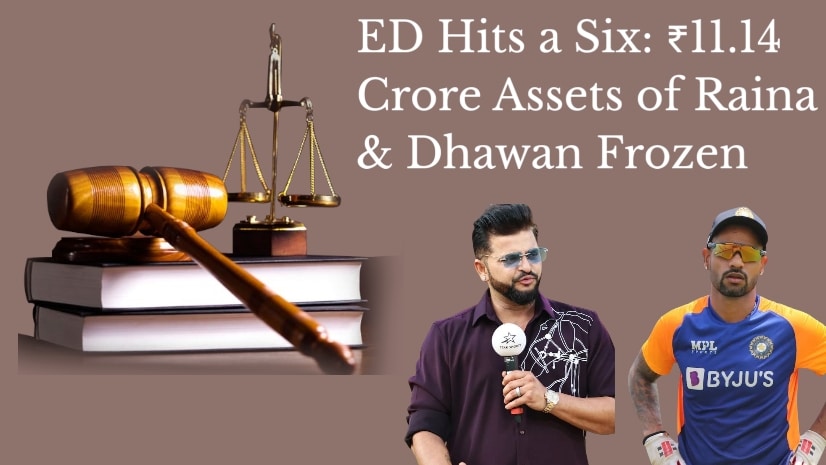
The order, issued under the Prevention of Money Laundering Act (PMLA), 2002, forms part of a sweeping probe into a major online betting and money-laundering network allegedly operating through thousands of fictitious bank accounts across India.
Breakdown of the ED’s Action
According to the ED’s Thursday statement, the assets frozen include both movable and immovable properties linked to the two retired players:
- Suresh Raina: mutual fund holdings worth approximately ₹6.64 crore.
- Shikhar Dhawan: a property valued near ₹4.5 crore.
Officials claim the cricketers’ names surfaced while tracking payments connected to a large-scale illegal betting platform that allegedly used over 6,000 “mule” bank accounts, multiple payment gateways, and shell entities to launder more than ₹1,000 crore.
The provisional attachment effectively bars sale or transfer of these assets pending the outcome of the investigation.
The Larger Context: Celebrity Endorsements Under Scrutiny
This episode raises pressing questions about the responsibility of celebrity endorsers in India’s rapidly expanding digital entertainment sector.
Regulators believe several high-profile personalities, including sportspersons and influencers, had promoted betting platforms that operated without the necessary permissions.
While endorsements per se are not illegal, the ED argues that knowingly promoting or profiting from an unlawful business can constitute participation in money-laundering or related offences.
The involvement of two major cricketing figures, both widely respected for their contributions to Indian cricket, magnifies the significance of this enforcement action.
Illegal Betting: The Financial Crime Angle
India’s online betting landscape sits largely in a grey zone, with only a few states permitting regulated gambling.
Unlicensed operators exploit this legal ambiguity to channel massive unreported cash flows.
According to the ED, the network at the centre of this case served as a money-laundering conduit—routing illegal funds through digital wallets, payment gateways, and shell companies to obscure their origins.
Such operations not only defraud tax authorities but also risk funding cybercrime and foreign-exchange violations.
The attachment of Raina’s and Dhawan’s assets signals the ED’s intent to treat proceeds from such deals as “proceeds of crime.”
Repercussions for Sports and Governance
Even though both cricketers have retired from professional cricket—Raina in 2022 and Dhawan in 2024—the case is likely to have ripple effects across the sports industry.
Experts believe the Board of Control for Cricket in India (BCCI) and sports endorsement agencies may soon impose tighter compliance norms for players and ex-athletes.
The development also underscores the need for due diligence in sponsorships. Sports personalities, often seen as role models, could face accountability if found endorsing or financially benefiting from suspect ventures.
Where the Players Stand
As of now, neither Raina nor Dhawan has released a detailed public statement responding to the ED’s move.
Reports suggest that both had signed endorsement deals through intermediaries associated with offshore entities.
The key legal question is whether they were **aware—or should reasonably have been aware—**that the platform they endorsed was illegal under Indian law.
The ED’s language in its press note hints that investigators believe the players entered these agreements with knowledge of the platform’s questionable status, though this will need to be tested in legal proceedings.
Next Steps in the Probe
The ED is expected to continue tracing fund flows, examining whether intermediaries or endorsement agencies acted as fronts, and determining if criminal intent can be established.
If sufficient evidence emerges, the provisional attachments may convert into formal confiscations, and charges under PMLA could follow.
Parallelly, the reputational impact on the cricketers could be immediate: brands may reconsider associations, and future endorsements could face stricter vetting.
For India’s celebrity ecosystem, this case may become a turning point—pushing for transparency clauses in all endorsement contracts.
Conclusion: A Cautionary Tale
For two players once celebrated for their brilliance on the field, this legal entanglement serves as a sobering reminder that fame offers no immunity from compliance obligations.
The ED’s move highlights a broader government push to dismantle the nexus between online betting, illicit finance, and celebrity promotion.
As investigations deepen, one thing is clear: in the modern era of digital endorsements, ignorance of legality is no defence.
Transparency, legal vetting, and ethical responsibility are no longer optional—they’re essential.